
Email : [email protected] | Phone : +91 800-780-5566
Chess in Schools for the Blind
Chess is a learning tool that just happens to be a game
Chess is a classic game of strategy, invented more than 1500 years ago in India. In the centuries since its invention, chess has spread to every country in the world. In all over world, it has also received endorsement by many educators and researchers. The word is out: Chess improves logical thinking skills. Studies demonstrate that math and reading scores improve when students learn chess. Thousands of sighted children are involved in chess training; many local, state and national tournaments draw from 300 up to over 2000 children each year. In India chess is growing very fast since 1990. More and more children are learning chess in systematic way. Result of this, in schools across the country, chess is making a strong contribution to sighted children's learning across academic areas. Chess is a learning tool that just happens to be a game.
Chess - Relevance to the Visually Impaired
Chess is particularly relevant for visually impaired person. It is the only game that the visually impaired can play against the sighted on an equal footing. In fact, visually impaired players have pitted their wits against sighted players in open tournaments and have acquitted themselves very well. Chess provides an opportunity for the visually impaired persons to prove that they can match the sighted, if not do better. Given the right exposure to tournaments, the accessibility to study material and computers (which the sighted have access to), visually impaired can outperform the sighted in this game.
Purpose
The objective is giving a blind individual the confidence to compete with their sighted counter part in each aspects of the life. To achieve this, teaching chess from young age is very essential. The best way to reach to young children is to teach chess in schools for the blind from which The need was to teach the chess in systematic way and should be able to implement and monitor the program in every corner of India
Why Offer Chess in Schools?
Chess is the only game where a blind person can play at par with his sighted counter part but even out perform them. This has been proved now and again in last 30 years in India in that matter at all over world. We are promoting this game because it gives us equal opportunity but there are lots of other benefits of chess.
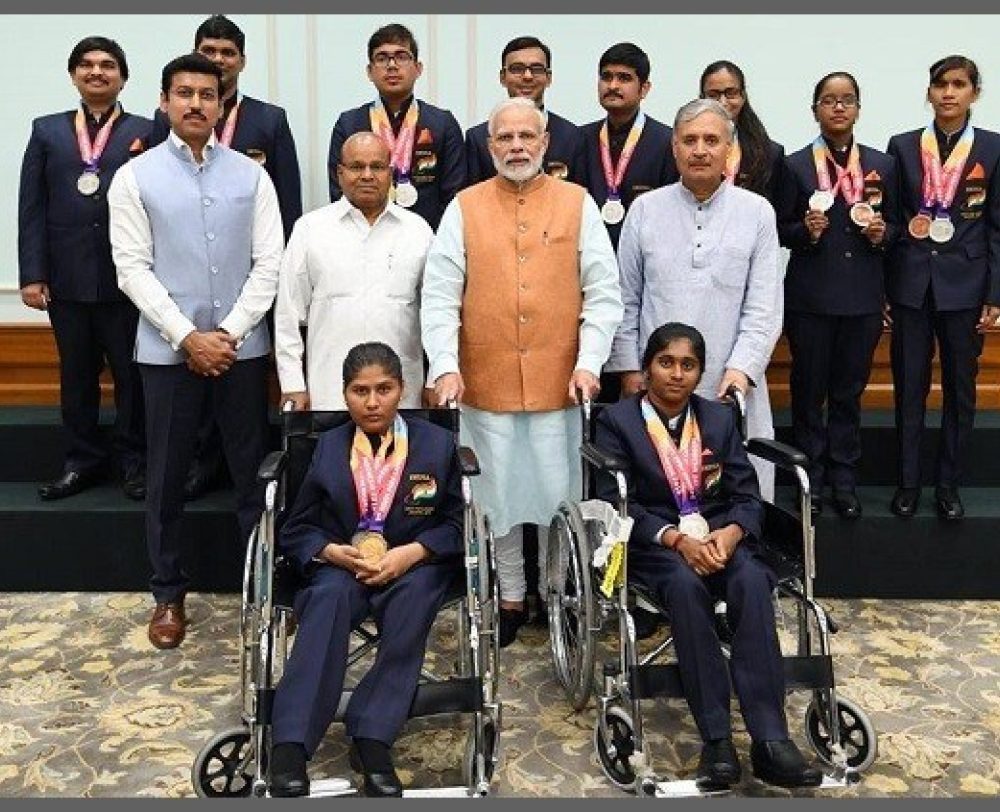
AICFB Players wins 1 Gold, 3 Silver and 1 Bronze in 3rd Asian Para Games 2018 at Jakarta Indonesia.
Academic Benefits
We have planning to bring chess in schools because we believe it directly contributes to academic performance. Chess makes kids smarter. It does so by teaching the following skills:
- Focusing: Children are taught the benefits of observing carefully and concentrating. If they dont watch what is happening, they cant respond to it, no matter how smart they are.
- Visualizing: Children are prompted to imagine a sequence of actions before it happens. We actually strengthen the ability to visualize by training them to shift the pieces in their mind, first one, then several moves ahead.
- Thinking Ahead: Children are taught to think first, then act. We teach them to ask themselves & If I do this, what might happen then, and how can I respond? Over time, chess helps develop patience and thoughtfulness.
- Weighing Option’s: Children are taught that they dont have to do the first thing that pops into their mind. They learn to identify alternatives and consider the pros and cons of various actions.
- Analyze Concretely: Children learn to evaluate the results of specific actions and sequences. Does this sequence help me or hurt me? Decisions are better when guided by logic, rather than just by impulse.
- Thinking Abstractly: Children are taught to step back periodically from details and consider the bigger picture. They also learn to take patterns used in one context and apply them to different, but related situations.
- Planning: Children are taught to develop longer range goals and take steps toward bringing them about. They are also taught of the need to reevaluate their plans as new developments change the situation.
- Evaluation of multiple considerations simultaneously: Children are encouraged not to become overly absorbed in any one consideration, but to try to weigh various factors all at once.
None of these skills are specific to chess, but they are all part of the game. The beauty of chess as a teaching tool is that it stimulates childrens minds and helps them to build these skills while enjoying themselves. As a result, children become more critical thinkers, better problem solvers, and more independent decision makers.